Showing posts with label Mexico. Show all posts

Tuesday, February 1, 2011

Villa DelPalmar Flamingo PV Mexico


January 2011 my girlfriend Leah and I took a week and went in search of warmer weather. We landed in a nice little resort called Villa DelPalmar Flamingo on the north end of Purteo Valarta, Mexico. We spent the week lying by the pool, walking the beach, shopping, riding horseback and taking little tours.

I highly recommend the location. It's far enough from PV that you need a bus or cab to get there, but close enough to enjoy it. There's a little village north of the resort with a great flea market.


Leah and I on the beach.

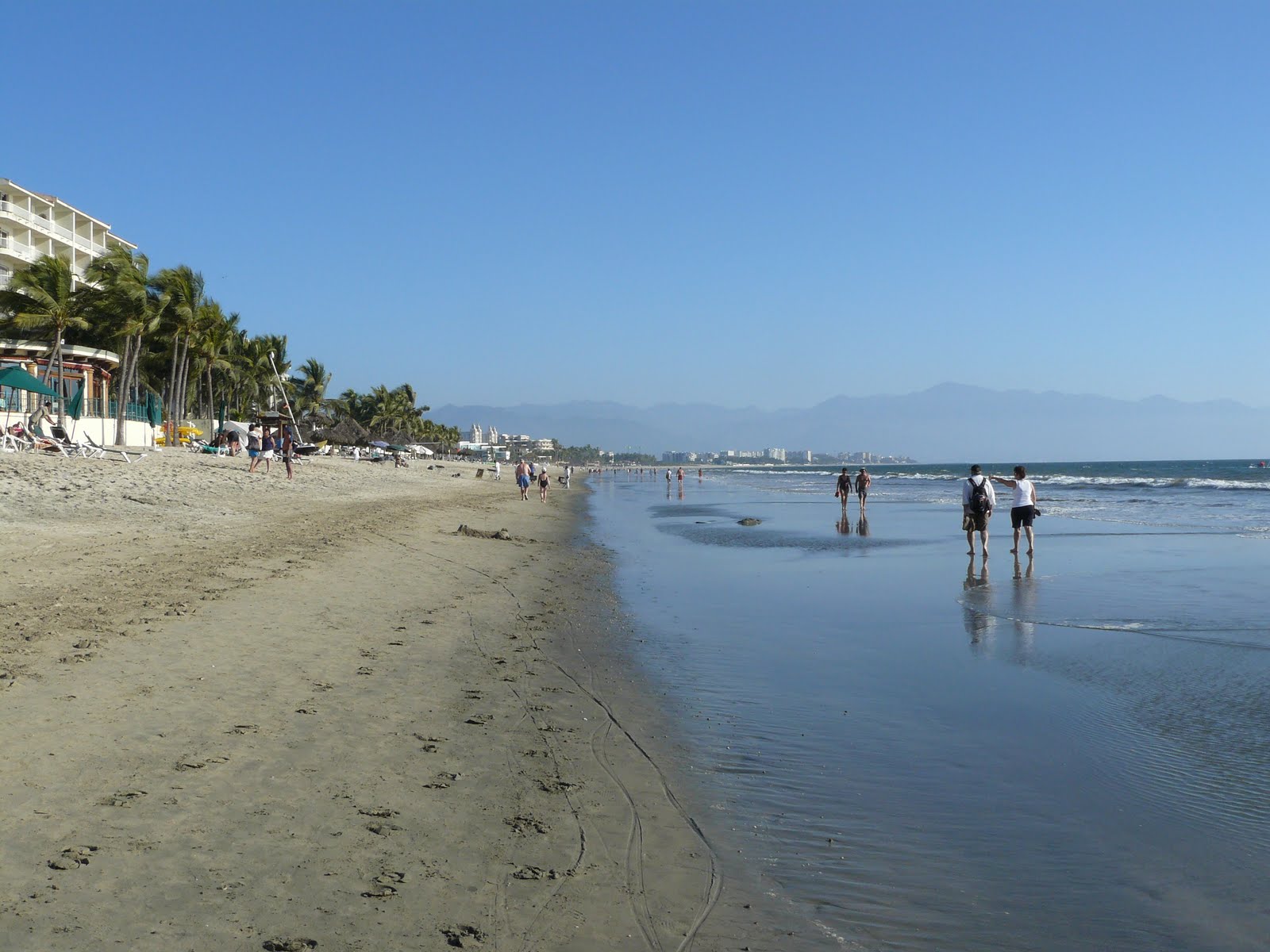
Walking the beach every morning seems to be a normal past time. It's peaceful and soothing, letting the stress peel away with every wave that washes over your feet.

Horseback riding is another great past time. We rode the beach and into the town, clopping, clopping on the cobblestones as we wandered down the streets with a guide.
Bucerias is directly north of PV on Banderas Bay. It's a tiny little village to wander on horseback and on foot, exploring and shopping. Many of the restaurants are decorated with murals inside and out.


We had a lovely lunch on the beach, watching the surf and dodging the beach vendors.

The view from our room. Villa Del Palmar Flamingo is a fairly new resort, all inclusive with 3 great restaurants and wonderful tiered pools.


The children's wading pool had wonderful sea turtles painted on the concrete.

Each pool contained a waterfall that tiered into the next pool.

And fountains to splash in.


Wed. night was a pirate show on the beach with a great buffet, bar and live entertainment.
Each table had its own ship centerpiece.

Leah enjoying a hammock on the beach.

The nicest guy in the resort.

Sunset over the pools. What a lovely way to spend the week.


Saturday, March 21, 2009

Last thoughts on Mexico

Since this is my last post about my trip to Cancun I thought I'd close with some photos of some of the different art found during the trip.

The arts are very important to the Mayans and the examples are everywhere.

From plaques on walls showing moon/sun/iguanas emblems. .....


.... to ceramic plates used for wall decorations


Murals of ancient legends telling stories of their history...


And swans made of towels in the resort.


Don't we clean up nice? Every now and again there are reasons to dress up and pretend to be ladies.

Enough of Mexico. On to the next adventure!

Thursday, March 19, 2009

My travel companions and friends

I have been reminded that I should acknowledge that not all the photos used in this blog were taken by me. Of course, if I'm in a photo, I can't be behind the camera.

Wade and Leah are responsible for many of the photos, especially the ones where I'm in front of the lens instead of behind it.

Leah loves flowers, people and 'small detailed shots. Wade likes the expansive landscapes beautiful people on the beach photos.


The three of us on a bus to somewhere.


Leah loves flower shots and spent a lot of time down in front of a blossom, looking for the perfect bud.


And she found the rolled up hammocks and all their colors incredible. If we could have gotten several home we would have.


Lots of beautiful flowers nestled in various gardens.

Monday, March 16, 2009

Cenotes and diving


Some cenotes have turned into wonderful places to dive. Since a lot of cenotes are interconnected divers can go from one to another underwater exploring caverns and underwater formations that are hidden in the dark.

You need a guide, a good light, lots of skill and enough nerve to allow you to go into a cave, in the water, in the dark except for your light.


To get to the cenote you put on all your gear, suit, weight belt, tanks, etc, and carefully manuever down a rock staircase with 50 lbs. on your back without falling over and hurting yourself or breaking something.


After you get to the water it's time to put on fins and mask, turn on your light and slip into the water. From there you go under the cave roof and aim for the next hole in the cavern roof that lets in the light.

Unless you total lose it and can't handle it. Yours' truly. Fortunately I figured it out in a very few minutes that going under rocks in the water is not my idea of fun.


The hole in roof of the cave that I came out of. Once I in the daylight, I was fine. The water was crystal clear and beautiful. Nice place to swim and snorkel.

This is a beautiful spot to sit and enjoy the water, from above. There are lots of cenotes over the peninsula that are dive sites. But I think I'll stick with snorkeling from now on when it comes to caves.

Sunday, March 15, 2009

Blue Cenote

Some of the scenery around the cenote. Because of a constant water source the greenery and size of the plants are incredible.

It is truly amazing. An awful lot of these plants are indoor plants in Alaska, nurtured and babied to keep them alive in arctic conditions.


The walk way around the cenote. It's a beautiful walk with huge plants and blooming flowers.


The bath-house shower complex behind the cenote.


The extensive gardens around the restaurant, gift shop and walk ways. There are little bungalows that can be rented scattered all through the complex.


The restaurant. A little bit pricey but good food. The staff is very friendly. English is not their strong point.

Saturday, March 14, 2009

Cenotes

Outside of Chichen Itza is a cenote called Xtoloc or 'Well of Xtoloc'. It's known as the 'Blue Cenote' by the travel guides etc.

A cenote is a sinkhole in the limestone, filled with freshwater. It was where the natives came to get water for thousands of years. They are scattered all over the Yucatan penisula. There are no rivers in the Yucatan, it's completly flat. Rain water seeped through the jungle growth, through the limestone and was trapped in the rock underneath. Over the centuries the water eroded the rock and the ground above collapsed. That's geologic history. But centuries ago the natives didn't realize that everything was interconnected. A cenote used in ritual sacrifices was the same water that downstream was used for drinking. The practice of throwing bodies into their water source helped lead to the downfall of the Mayan people.

Today many of the cenotes are still used for water and many more are a spot for recreation. From snorkeling to diving, people enjoy the crystal clear water and the cool temperatures. The Blue cenote has a complex built around it that allows easy access to the sinkhole. Stairs in the rock in an undergound tunnel lead downward. Ladders in the rock help you enter the water if you don't feel like jumping.

There's even a platform high over the water if you are really brave for a dive. A 'lifeguard' watches over it and you can rent life jackets if you're not comfortable with your swimming skills. The water is much cooler than the ocean, taking on the temperature of the surrounding rocks. It can be quite the shock when you first hit it.

Roots from the plants above strain toward the water and there are signs proclaiming 'don't pull on the plants.' A type of catfish live in the water, dark black and totally oblivious to the humans splashing around. Water seeping through the overhanging limestone rains down in small waterfalls.

The facility around the cenote includes showers, lockers, a restaurant and a gift shop. Everything is spotless with attendants cleaning and assistants for lockers and towels. Of course there is a tip jar everywhere, but a few pesos dropped in a bowl is a small price to pay for such wonderful facilities in the middle of nowhere.

If you plan to swim for any length of time I would recommend a shorty wetsuit. The water gets cold fast. I had a 'sharkskin' suit with me and was very happy to have it after a few minutes.

Thursday, March 12, 2009

More of Chichen Itza

Images on the walls on either side of the ball court. Modern interpretations translate the carvings into a story of playing a deadly game, with the winning captain sacrificed to the gods. Some theorize that teams were from tribes scattered over a large area and this location was the 'play-offs' of a large scale competition. It was an honor to play and even more of an honor to die.


Kukulcan, the serpent god. The vertical rendition of Kukulcan is a representation of the shadow of the god that descended the stairs on the spring and fall equinox.

The iguanas know who their friend is.


More carvings telling the number of games, the number of players, sacrificed , and the gods that waited for the blood. The ruins at Coba aren't as detailed and there is no mention of bloody games. Some believe that the Toltec influence is at its greatest here, which started the tradition of sacrifices.

Wednesday, March 11, 2009

Chichen Itza

The world famous Chichen Itza temple. The one ruin that immediately is associated with the Mayan culture. This site is so incredible. On the spring and fall equinox the sun casts a shadow of a serpent that moves down the pyramid and into the ground. Thousands gather at sunrise to watch the image and marvel at what was built by a culture that had no tools beyond bronze age technology. 3 years ago the sky was cloudy and the shadow did not appear on the spring equinox. The Mayans immediate said that was a sign of impending terrible weather. Hurricane Wilma lashed the Yucatan peninsula that summer.


Me and the tour guide at Chichen Itza. He is of Mayan descent and is extemely knowledgeable of the history, legends, and archaelogical significance of the ruins. While the ruling class of the Mayans, the kings and priests, were slaughtered by the Europeans in the 1500s, the working class and the farmers/hunters disappeared into the jungle. The Mayan language and culture still exist today with over 3 million people descended from the lost civilation. Unfortunately, the huge library of the Mayans were lost with the slaughter of the upper class. Rumor has it that one of the books containing the history/knowledge of the Mayan people is hidden in the Vatican, hidden away from anyone who could interpet what it means.

The temple of the warriors in the background with 'the garden of columns' that was thought to have held a thatch roof over the area. This area is immense and was thought to be some type of market place.

On top of the temple of the warriors is Chac Mool. He is reclining, with a bowl on his lap, supposedly waiting for a sacrifice. Of course, we don't know what the 'sacrifice' was.

Students of the Chichen Itza ruins believes that this represent the heads of slain warriors, mounted on poles as a warning to invaders or warring neighbors. Some believe that this practice started when the Toltecs started to influence the Mayan culture.

The other large icon of the Mayan culture is this ball court at Chichen Itza. This is not the beginning of basketball! Archaelogists believe that the ball used in this game was about 17 pounds and hands weren't allowed to pass the ball. At the end of the game the winning captain was beheaded, sacifaced to the gods for his skill.

Tuesday, March 10, 2009

Walking Tulum

The ruins overlooking the ocean. From here you can see the ships crossing the horizon, from cruise ships, sailing vessels and ancient square riggers from across the ocean.


The buildings of Tulum still carry the carvings from the Mayans who lived here centuries ago. Study of the carvings tell of a rich history linked to the star observations, the seasons and the rain. The posts may be the foundation for posts that held up a roof, or maybe statues. The imagination does wonders as you walk the paths, imaging what was here thousand of years ago.

Manny, our tour guide for Tulum was of Mayan descent, his grandfather only spoke the Mayan language. He wove the stories of Tulum as we walked through the remains of the ancient city, emphasizing what was known from years of study, what had been passed down over the centuries. The one thing he was admant about, they weren't aliens, then or now.

The only local resident that lives within the remains of the city. Iguanas were every where and posed for our cameras without hesitation. You could see them sunning themselves on the tops of the walls, eyes watching the two legged invaders.